Insights

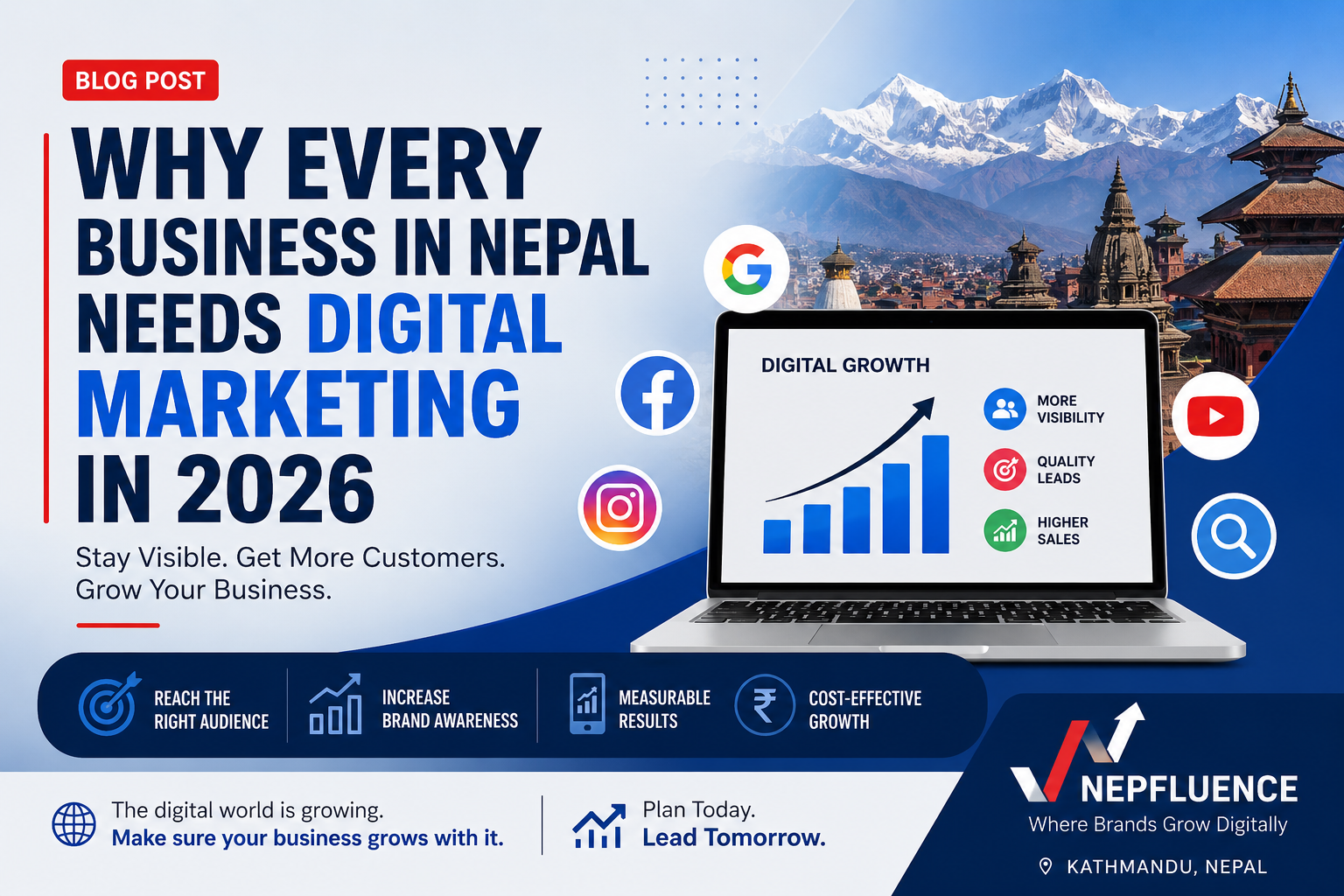
Why Every Business in Nepal Needs Digital Marketing in 2026

July 2026 8 min readDigital Marketing
Digital marketing in Nepal 2026 — Nepfluence

Think about the last time you bought a product, booked a hotel in Pokhara, or looked for a reliable school in Kathmandu. Where did you start your search? Chances are, you opened Google or scrolled through your social media feed. Your customers are doing the exact same thing right now.

The marketplace in Nepal has fundamentally shifted. Traditional marketing methods like billboards, newspapers, and flyers are no longer enough to capture consumer attention. As we move through 2026, the internet is no longer a luxury — it is the primary battlefield for business survival and growth.

Whether you run a local boutique in New Road, a manufacturing plant in Biratnagar, or a modern cafe in Lalitpur, consumer habits have permanently evolved. This guide outlines exactly why digital marketing in Nepal is mandatory for your business in 2026 and provides actionable steps to dominate your market.

1. The Digital Revolution in Nepal: 2026 Reality Check

Nepal's digital landscape has experienced explosive growth. High-speed 4G and 5G networks now reach deep into rural provinces, moving beyond major metropolitan hubs. Affordable smartphones and cheap data packs have turned millions of citizens into hyper-connected consumers.

Consumers do not just use the internet for entertainment anymore. They use digital channels to make purchasing decisions, read peer reviews, pay bills via digital wallets like eSewa and Khalti, and purchase items online. If your business lacks an optimized online presence, you are effectively invisible to a massive segment of your potential market.

2. Why Traditional Advertising Alone is Failing

Traditional advertising methods are becoming increasingly inefficient for modern businesses. Printing banners, renting highway billboards, or publishing print advertisements inside traditional newspapers require significant financial investment with no guaranteed returns.

The fundamental issue with traditional marketing is its lack of precise audience targeting. When you pay for a massive billboard along the Ring Road, you pay to display your message to everyone — regardless of whether they have an interest in your specific product or service. This approach leads to heavy budget waste.

Furthermore, traditional print advertisements lack accurate analytics. There is no reliable mechanism to track exactly how many individuals saw your flyer or how many sales resulted from a specific newspaper advertisement. In 2026, operating a business without data-driven tracking is a high-risk approach.

3. Core Benefits of Digital Marketing for Nepalese Businesses

Implementing targeted digital marketing campaigns provides significant operational advantages. It levels the competitive field, allowing local small and medium enterprises (SMEs) to compete directly with large international corporations.

Hyper-Targeted Customer Reach

Digital channels allow you to target your ideal customer profile with precise accuracy. You can build targeted campaigns based on explicit demographic metrics, geographical locations, specific age brackets, and consumer interests.

For instance, an adventure travel agency in Kathmandu can explicitly configure campaigns to reach international tourists or affluent local professionals who actively research trekking routes. This ensures your budget is spent exclusively on high-value prospects.

Cost-Effectiveness and High ROI

Digital campaigns can be launched with highly scalable budgets, unlike costly traditional media placements. Platforms like Meta Ads and Google Ads allow you to set strict daily spend caps that can be adjusted in real time based on performance.

This structural flexibility ensures excellent return on investment (ROI). You can allocate smaller test budgets to individual campaigns, analyze conversion performance, and scale up budgets only on high-performing variations.

Real-Time Performance Tracking

Digital marketing removes guesswork from your business metrics. Modern analytics dashboards show you exactly how many individuals viewed an ad, clicked your call-to-action button, and completed a purchase on your website. Access to instant performance metrics allows you to pivot and optimize your campaigns actively.

4. Essential Digital Marketing Strategies for 2026

Achieving sustainable business growth requires a multi-channel approach. Depending on a single platform leaves your visibility vulnerable to algorithmic changes. A diversified digital strategy builds long-term organic equity.

Search Engine Optimization (SEO)

SEO is the foundation of long-term sustainable digital visibility. When consumers search for solutions like "best dental clinic in Kathmandu" or "reliable logistics company in Nepal," your business needs to appear at the top of the search results. Investing in specialized SEO ensures a continuous flow of inbound leads over time.

Social Media Marketing (SMM)

Social media platforms like Facebook, Instagram, and TikTok serve as primary discovery channels for Nepalese consumers. Building an engaged community on these channels fosters brand loyalty and facilitates direct communication. Businesses must focus on producing high-value, educational, or highly engaging video content.

Localized Performance Marketing

Paid ad campaigns on Google and social media provide immediate visibility and traffic. Utilizing location-based targeting allows you to serve ads to users within a specific radius of your physical storefront, driving highly qualified local foot traffic.

5. Traditional vs. Digital Marketing Comparison

Feature MetricTraditional MarketingDigital Marketing (2026)
Financial Entry BarrierHigh — expensive print, TV, billboard costsLow — scalable budgets for any size
Targeting PrecisionBroad & generalizedHyper-precise demographic & behavioral
Performance AnalyticsImprecise, vague estimationsGranular, real-time dashboards
Audience InteractionOne-way static communicationTwo-way real-time engagement
Long-Term Value EquityStops when funding endsSEO assets keep compounding

6. Overcoming Common Challenges in Nepal's Digital Space

Transitioning into digital operations can present clear challenges for local business owners. A major obstacle is navigating irregular digital literacy and selecting reliable growth partners. Many businesses struggle initially because they expect overnight miracles or run unfocused, unoptimized ad campaigns.

Succeeding in 2026 requires patience, continuous optimization, and an ongoing focus on providing real value to your audience. Partnering with an experienced agency helps you avoid costly trial-and-error phases.

7. Frequently Asked Questions

How much budget does a business in Nepal need for digital marketing?

Digital marketing budgets are highly flexible. Small local businesses can start with minimal daily ad spends on social media platforms, while larger enterprises allocate substantial monthly investments toward comprehensive multi-channel strategies including advanced SEO, content creation, and automated email workflows.

How long does it take to see measurable results from SEO services?

SEO is a medium to long-term strategic investment. Paid ad campaigns can drive immediate traffic within hours, but organic search optimization typically requires 3 to 6 months of consistent effort to establish high authority rankings on Google. This traffic is highly sustainable and costs nothing in ad spend over time.

Is TikTok marketing effective for B2B businesses in Nepal?

Yes. TikTok has evolved significantly in 2026 — it is no longer just for entertainment. Informative short-form video content that showcases expertise, corporate case studies, or operational efficiency can effectively engage professional decision-makers and founders.

Transform your business growth

Don't let your competitors win the digital race.

Nepfluence is Kathmandu's data-driven growth partner. Get a free, zero-obligation strategy call and a custom roadmap for your brand.

Get Your Free Consultation